

Cats Live Here
Crystals - Chiastolite Bracelet
Crystals - Chiastolite Bracelet
Couldn't load pickup availability
Adorn your wrist with the timeless beauty and energy of crystal gemstone bead bracelets. Each bracelet is handcrafted from carefully selected metaphysical crystals, allowing you to carry their natural vibration and healing properties wherever you go. From the calming energy of amethyst to the grounding power of black tourmaline, these crystal bracelets are more than jewellery—they are wearable tools for balance, manifestation, and spiritual growth.
Crystal bead bracelets have been treasured for centuries for their ability to connect the wearer to the Earth’s energy, enhance intuition, and support emotional, spiritual, and physical wellbeing. Each bead radiates its unique energy, creating a harmonious flow that inspires mindfulness, positivity, and transformation throughout your day.
These metaphysical crystal bracelets appeal to spiritual seekers, meditation practitioners, crystal collectors, and anyone drawn to self-care, mindfulness, or manifestation practices. Worn alone, they provide a subtle, personal touch, and stacked together, they amplify both energy and style. Perfect for gifting or treating yourself, these crystal bracelets combine meaning, elegance, and metaphysical power in every piece.
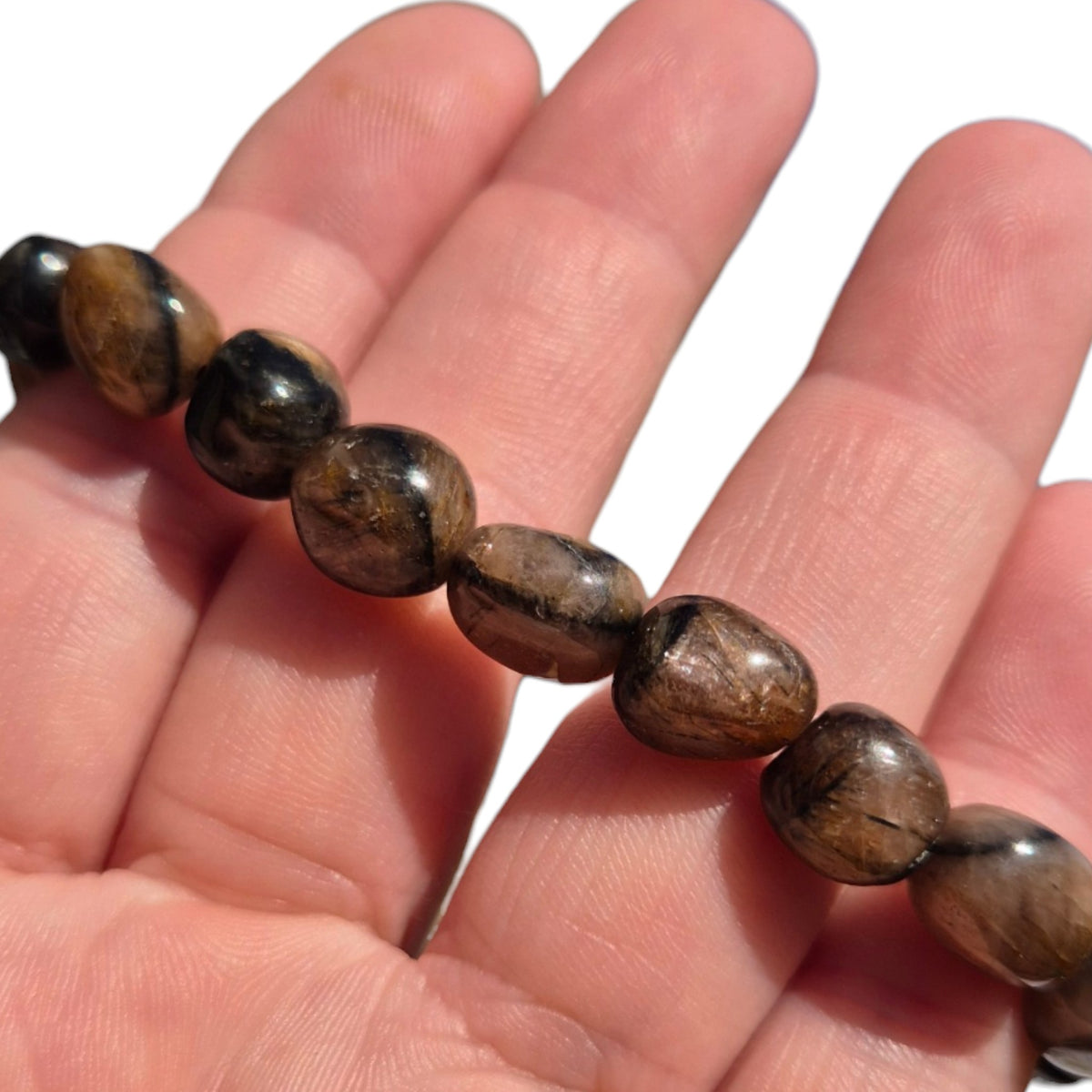
Pics are an example of the bracelet you will receive.
NOTE: These are natural crystals and may have natural imperfections and variations in colour.
Weight:
Size:
About Chiastolite
Chiastolite is a distinctive variety of andalusite (aluminium silicate), immediately recognisable by the natural dark cross that appears through the centre of the crystal when viewed in cross-section. This remarkable pattern isn't carved or artificially created. It forms naturally as the crystal grows, with carbonaceous material, commonly graphite, becoming concentrated into characteristic cross-shaped inclusions.
The name Chiastolite comes from the Greek word chiastos, meaning “cross-marked” or “crosswise”, referring directly to this unusual natural formation. Its earthy colouring, typically ranging from tan and reddish brown to deeper brown and grey, contrasts beautifully with the dark brown or black cross at its centre. With a Mohs hardness of approximately 6.5–7, Chiastolite is relatively durable, although individual specimens may contain inclusions, fractures or areas of matrix that require more careful handling.
Chiastolite forms within metamorphic rocks, particularly when clay-rich sedimentary rocks such as shale undergo changes in heat and pressure. Andalusite crystallises under these conditions, incorporating surrounding material as it grows. Because andalusite forms within a particular range of metamorphic conditions, it is also useful to geologists as an index mineral, helping to reveal something of the geological conditions experienced by the surrounding rock.
Notable deposits of Chiastolite have been found in Spain, France, Russia, China, Chile, Brazil, the USA and Australia. Spanish Chiastolite is particularly significant historically, with cross-bearing stones from the region around Santiago de Compostela becoming associated with Christian pilgrimage and protection.
Chakras – Root (Primary), Sacral
Zodiac – Libra
Element – Earth
Planet – Saturn
Number – 3
Birthstone – Not an official birthstone, but traditionally associated with protection, transition and transformation
Typical colours – Brown, reddish brown, tan, grey and occasionally greenish brown, usually displaying a dark brown to black cross-shaped inclusion
Healing with Chiastolite
♥ Protection ♥ Grounding ♥ Boundaries ♥ Transformation ♥ Transition ♥ Courage ♥ Stability ♥ Resilience
Chiastolite is traditionally regarded as a powerful stone of protection, grounding and transformation. Its naturally occurring cross has long contributed to its reputation as a protective talisman, while in modern crystal healing it is often used to establish strong energetic boundaries and maintain a sense of stability during challenging or uncertain periods.
Emotionally, Chiastolite is associated with resilience and the ability to remain centred when circumstances are changing. It can be particularly supportive during major transitions, including changes in relationships, careers, homes, personal beliefs or long-established patterns. Rather than resisting change, its energy encourages acceptance of transformation while maintaining a strong connection to your own foundations.
Spiritually, Chiastolite has become associated with crossroads, ancestral work, protection and the cycles of death and rebirth. It may be used during meditation or spiritual practice when exploring endings, beginnings and the space between the two. Its grounding qualities also make it a useful companion for practices that involve becoming more energetically receptive, helping maintain a symbolic connection to the physical world while undertaking deeper spiritual work.
Energetically, Chiastolite is considered a strongly grounding and protective stone. Rather than creating an aggressive or defensive form of protection, its energy is traditionally regarded as stabilising, helping to reinforce personal boundaries while allowing you to remain calm, present and centred.
Its natural cross makes Chiastolite particularly significant for crossroads and transitional periods. The four arms can symbolically represent different directions, choices or possibilities, while the centre represents the point at which they meet. For this reason, Chiastolite can be particularly useful during decision-making, when several possible paths are available or when you're moving away from one stage of life without yet knowing exactly what comes next.
Its geological formation also provides a beautiful natural representation of transformation. Chiastolite develops through metamorphism, where existing material is altered through heat and pressure rather than completely destroyed. Energetically, this reflects the idea that transformation doesn't require abandoning everything that came before. Experience can be integrated, reshaped and carried forward into something new.
In manifestation, Chiastolite is particularly suited to intentions involving stability, protection, resilience, boundaries and lasting change. Rather than focusing purely on attraction, it can be used to establish strong foundations from which an intention can develop. It may also be incorporated into protective crystal grids, crossroads workings, ancestor practices and rituals involving the four directions or elements.
Physically, Chiastolite is traditionally believed within crystal healing practices to support strength, vitality, circulation and the nervous system. Its grounding energy is also associated with recovery from exhaustion and periods of prolonged physical or emotional stress.
It is sometimes used energetically to encourage overall balance within the body, particularly when stress or emotional overwhelm has left someone feeling depleted or disconnected from their physical needs.
Chiastolite's grounding associations also make it a useful stone to hold during meditation, breathing exercises and relaxation practices. Its smooth, tactile surface and distinctive central cross can provide a physical point of focus, encouraging awareness of the body and the present moment.
Crystal healing is a complementary spiritual practice and shouldn't be considered a substitute for professional medical advice, diagnosis or treatment.
Historical & Cultural Notes
-
The name Chiastolite comes from the Greek chiastos, meaning “cross-marked” or “crosswise”, referring to the distinctive cross visible within the stone.
-
Chiastolite is a variety of andalusite, an aluminium silicate mineral with the chemical formula Al₂SiO₅.
-
Its characteristic cross is formed by dark inclusions, commonly carbonaceous material such as graphite, which become arranged into distinctive geometric patterns as the crystal grows.
-
Chiastolite-bearing rocks from Galicia in Spain, particularly around Santiago de Compostela, became historically associated with Christian pilgrimage and protective religious symbolism.
-
Cross-bearing specimens were carried as protective and devotional objects, their natural markings being readily interpreted through Christian symbolism.
-
Chiastolite is sometimes historically referred to as a Cross Stone, although this name is also applied to staurolite, another mineral famous for naturally occurring cross-shaped formations.
-
The cross itself is entirely natural rather than carved or engraved, resulting from the mineral's growth within its surrounding metamorphic rock.
-
Andalusite is an important index mineral in geology. Its presence can help geologists determine the temperature and pressure conditions experienced by metamorphic rocks.
-
Andalusite, kyanite and sillimanite share the same chemical formula, Al₂SiO₅, but possess different crystal structures and form under different pressure and temperature conditions.
-
Chiastolite has been found in several parts of the world, including Spain, France, Russia, China, Chile, Brazil, the USA and Australia.
-
In contemporary spiritual practice, the four arms of Chiastolite's cross are sometimes associated with the four directions, four elements and the meeting of different energetic paths, although these interpretations are predominantly modern metaphysical associations rather than documented ancient traditions.
Chiastolite is a deeply grounding stone of protection, transformation and the crossroads. Its extraordinary natural cross serves as a reminder that change doesn't always mean leaving the past behind. Sometimes transformation is the process of taking what already exists, reshaping it under pressure and allowing it to become something entirely new.
Share